The following article was written by Jing Wang, a youth fellow at China House Kenya
“Whatever you do in Kenya, you avoid meddling with wildlife affairs — they get you into serious trouble”, said Angela Chang who has stayed in Kenya for more than 15 years and witnessed the change of Chinese participation in illegal wildlife trade, “Here sometimes animal lives matter more than those of humans.”
Since 1960s, Chinese began to arrive in Kenya and the population of Chinese in Kenya grew to about 60,000, according to estimation of Chinese community leaders. Alongside Chinese modern migration, one particular local trade boosted- the illegal ivory trade.
According to some Chinese residents who have been in Kenya for long, before 2010, many Chinese people who came to Kenya were advised either by their friends or local guides to purchase ivory products as souvenirs for their families, since they were cheap and carried with themselves cultural values treasured by the Chinese- ivory carving in 2006 was officially designated as a national intangible cultural heritage in China.
Daisy Deng, a Chinese lady who came to Kenya as early as 2003, claimed to have bought five ivory bangles for her friends back in 2007 under the advice of her local Chinese friends. She bought those bangles for 300 shillings (about 3 US dollars) each, a price significantly low compared to those in China which cost at least 1000 USD per bangle, and brought them back in her suitcases, which did not undertake much inspection.
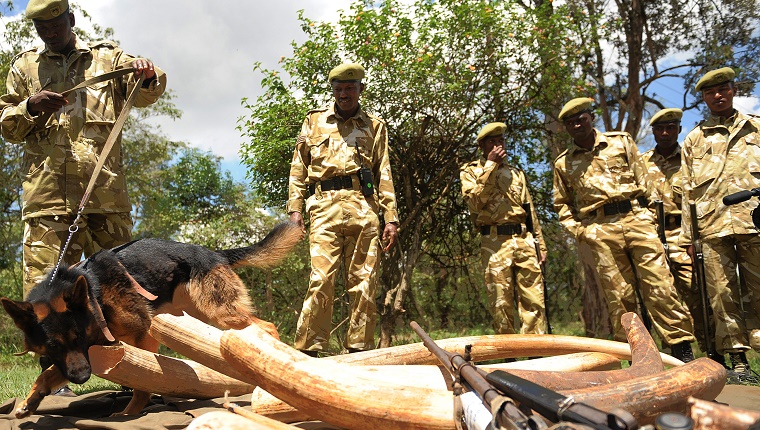
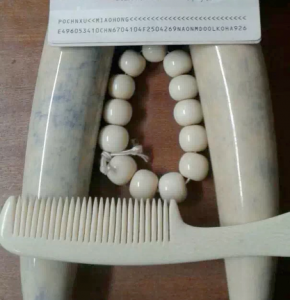
Caroline Lin, secretary of a local Chinese association, admitted to have bought several ivory trinkets back in 2009. She explained that she was pretty ignorant of how ivory was acquired, not to mention ivory’s true value back then, and she bought ivory purely out of the reason that every one else[ Chinese] was buying it. Image of seized contraband ivory circulated on Chinese social media.
This rampant situation of purchasing ivory products in Kenya continued until 2010 when the Wildlife Bill began to take shape; law enforcement gradually became strict. This incurred several seizures of ivory at the Jomo Kenyatta International Airport, with exposure showcasing consequences those criminals had to face.
“A total of 2,000,000 US dollars were fined in 2013”, remarked David Wu, one prominent Chinese business leader in Kenya who usually helps bail Chinese people out from jail after they got arrested, “there were Chinese nationals getting caught at the airport every month in 2011”, he said, “sometimes there were as many as three cases per night.”
Ivory seizures involving local Chinese nationals from Kenya slowly diminished after 2015, and many interviewees during our investigation stated firmly their attitude that they would not touch ivory products at all. In 2016, a manager of a Chinese state-owned enterprise who was offered a raw ivory tusk for 5,000 shillings by a Kenyan worker on his construction site firmly refused this deal.
Chinese people’s change of attitude towards ivory trade may have happened for good reasons.
Firstly, many Chinese interviewees explained their change of attitude with the reason that “ the price is too high to pay”, a sentence that could be interpreted at two layers of different meanings.
One layer is that as more and more people became interested in ivory, the price for ivory skyrocketed, which makes ivory undesirable for the group of Chinese who were mainly attracted by the low price of ivory. “Ivory products were much cheaper many years ago…they do not worth that much money demanded nowadays”, exclaimed a business migrant who has stayed in Kenya for twenty years. In the eyes of his and other Chinese, ivory is worthy of being purchased only at low price.
The other layer is that as more and more Chinese nationals got caught and were fined heavily, therefore many local Chinese are scared by the consequences they have to face if they ever get caught with ivory products.
On April 28th, 2014, four Chinese nationals were caught in possession of ivory and paid a fine of 520,000 RMB.
On May 14th, 2014, one Chinese national was caught carrying more than ten ivory bracelets and pendants, which weighed up to 1.5 pound. He was imprisoned for half a year.
“You know how popular us Chinese people were with the local newspaper”, joked one Chinese manager who runs a private-owned enterprise in Kenya, “the local media follow us up like paparazzi and that’s how the local Chinese people receive information about major ivory seizures involving Chinese nationals and the harsh punishments they had to face….we read about such cases almost every week… we are all constantly reminded of and frightened by those terrible consequences… we dare not touch ivory products again”.
Secondly, under the pressure of strict enforcement of WCMA, the Chinese embassy in Kenya and a lot of Chinese enterprises began to promote the importance of wildlife conservation and the legal consequence of involvement.
For instance, one Chinese state-owned enterprise educates their employees of the local legislation that forbids trade in ivory before they come to Kenya; after they arrive in Kenya, the enterprise will take them to a special meeting arranged by the enterprise that educates them again of the local law and the consequences of participating in illegal ivory trade.
Thirdly, many Chinese people in Kenya are enraged by such cases that corrupt officials in Kenya purposefully malign the Chinese of illegally buying ivory and therefore tried to clear Chinese notorious reputation as ivory buyers.
In 2016, several policemen searched Mr. Bob (a Chinese businessman) in the name of a security check. After Mr. Bob returned from a phone call outside the silo, the policemen showed him a raw tusk of ivory and claimed to have found it in Mr.Bob’s stockpiles. Mr.Bob was terrified because he had never purchased any ivory before, not to even mention putting it in his silo. Moreover, when the footage of camera hidden in the silo was checked, it showed clearly that the policemen went directly to a corner of the silo, with their back to the camera, and “ found” the ivory tusk easily, as if they had previous knowledge about the hidden place of the ivory. This case remains controversial and has not been concluded yet.
« Today no Chinese in Kenya would touch ivory,” said David Wu who still helps bail Chinese out of jail. Today, he is still busy, although the Chinese he bails out from Jomo Kenyatta Airport police station are usually on transit, mostly from Mozambique and DRC.
“90% of them are from Mozambique,” said David.
The controversial 2007 Sicomines infrastructure-for-natural resources deal between China and the Democratic Republic of the Congo is a milestone in Sino-Africa ...
By Huang Hongxiang, Special to The China Africa Project Rhino horn, ivory, shark fin, lion bone, abalone, pangolin, turtle, timber… You could make a really long list about the Chinese-related environmental problems in Africa. ...
Le Projet Afrique-Chine est fondamentalement independent, non-partisan et ne fait la promotion d’aucun pays, compagnie ou culture.
Actualité
Une sélection minutieuse des articles les plus importants de la journée sur la Chine et l’Afrique. Mise à jour 24 heures sur 24 par des rédacteurs humains. Pas de robots, pas d’algorithmes
Analyses
Des points de vue divers, souvent non conventionnels, d’universitaires, d’analystes, de journalistes et de diverses parties prenantes du débat Chine-Afrique.
Réseau
Un réseau de professionnels unique, composé de chercheurs, d’analystes, de journalistes et d’autres acteurs de la Chine et de l’Afrique du monde entier.
We use cookies on our website to remember your login status and manage your subscription access. By clicking “Accept”, you consent to the use of ALL the cookies.
This website uses cookies to improve your experience while you navigate through the website. Out of these, the cookies that are categorized as necessary are stored on your browser as they are essential for the working of basic functionalities of the website. We also use third-party cookies that help us analyze and understand how you use this website. These cookies will be stored in your browser only with your consent. You also have the option to opt-out of these cookies. But opting out of some of these cookies may affect your browsing experience.
Necessary cookies are absolutely essential for the website to function properly. These cookies ensure basic functionalities and security features of the website, anonymously.
Cookie
Durée
Description
cookielawinfo-checbox-analytics
11 months
This cookie is set by GDPR Cookie Consent plugin. The cookie is used to store the user consent for the cookies in the category "Analytics".
cookielawinfo-checbox-functional
11 months
The cookie is set by GDPR cookie consent to record the user consent for the cookies in the category "Functional".
cookielawinfo-checbox-others
11 months
This cookie is set by GDPR Cookie Consent plugin. The cookie is used to store the user consent for the cookies in the category "Other.
cookielawinfo-checkbox-necessary
11 months
This cookie is set by GDPR Cookie Consent plugin. The cookies is used to store the user consent for the cookies in the category "Necessary".
cookielawinfo-checkbox-performance
11 months
This cookie is set by GDPR Cookie Consent plugin. The cookie is used to store the user consent for the cookies in the category "Performance".
viewed_cookie_policy
11 months
The cookie is set by the GDPR Cookie Consent plugin and is used to store whether or not user has consented to the use of cookies. It does not store any personal data.
Functional cookies help to perform certain functionalities like sharing the content of the website on social media platforms, collect feedbacks, and other third-party features.
Performance cookies are used to understand and analyze the key performance indexes of the website which helps in delivering a better user experience for the visitors.
Analytical cookies are used to understand how visitors interact with the website. These cookies help provide information on metrics the number of visitors, bounce rate, traffic source, etc.
Advertisement cookies are used to provide visitors with relevant ads and marketing campaigns. These cookies track visitors across websites and collect information to provide customized ads.

 Secondly, under the pressure of strict enforcement of WCMA, the Chinese embassy in Kenya and a lot of Chinese enterprises began to promote the importance of wildlife conservation and the legal consequence of involvement.